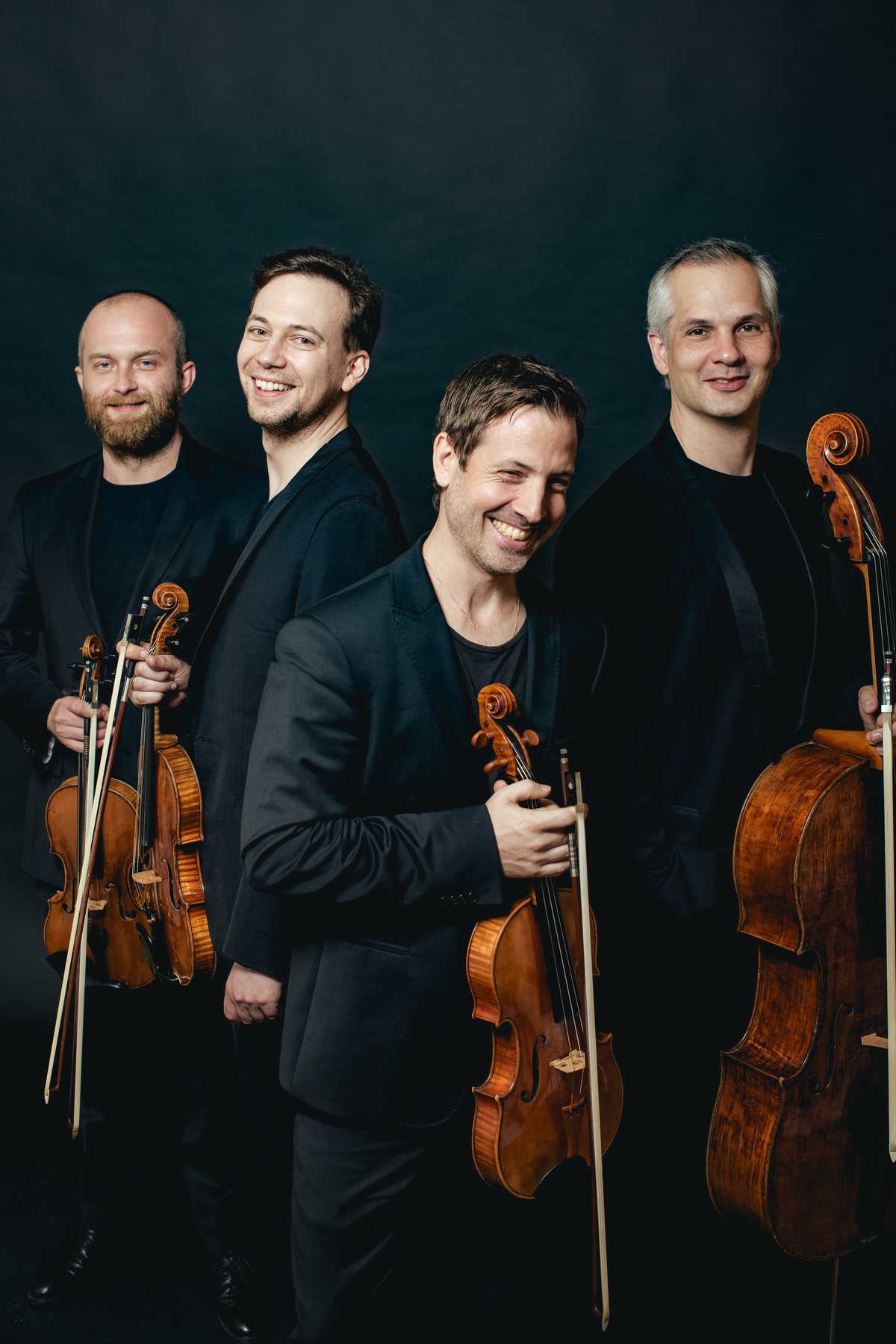
Daniel Auner violin · Cristian Ruscior violin · Georg Wimmer viola · Konstantin Zelenin violoncello
It seemed that once again a truly ‘Viennese quartet’ was needed — one that engages with the music of this city from the early 20th century with the necessary quality and enthusiasm …
Günter Pichler, Alban Berg Quartett, on the Auner Quartett, spring 2026
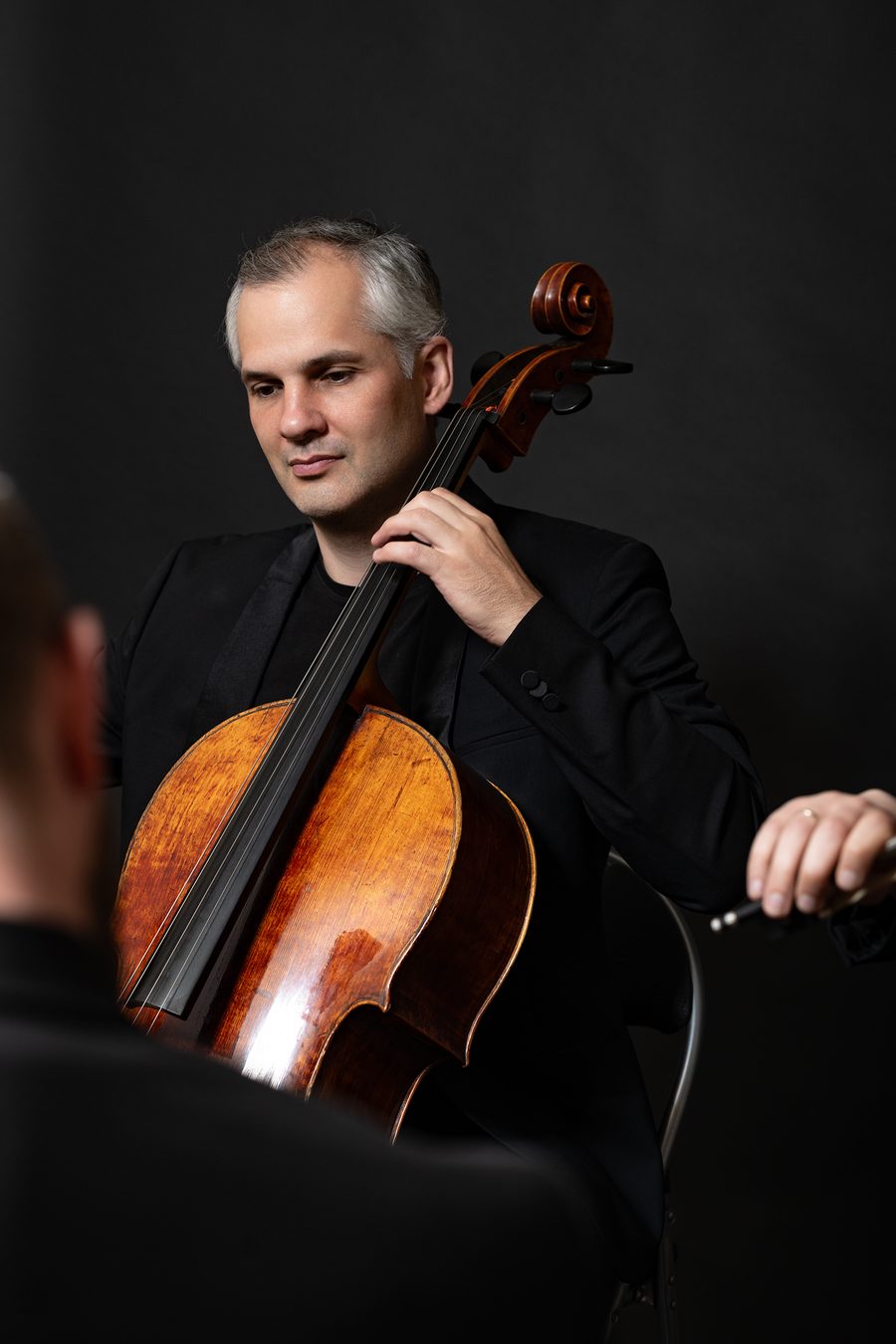
Photo: Damián Posse
Named after the great-great-aunt of its first violinist, the Viennese violinist and composer Mary Dickenson-Auner, and founded in 2013, the ensemble has established itself as one of the most distinctive of its generation on the international chamber music scene. It has won several national and international competitions, including the renowned Eugène Ysaÿe Competition in Liège in 2018. As the first Austrian ensemble to do so, it subsequently graced the cover of the Performing Arts Yearbook of Europe under the headline “Auner Quartett – The award-winning string quartet: a perfect musical match.”
In the 2020/21 season, the Auner Quartett was appointed Cultural Ambassador of Austria by a jury of the Ministry of Foreign Affairs (as part of the “New Austrian Sound of Music” programme), and has since performed regularly at cultural forums and embassies around the globe. Inspired by the historical Viennese salon culture, the four musicians launched their own chamber music series in 2016, which from the 2026/27 season onward will take place in the halls of the Vienna Musikverein.
In this exclusive concert series titled “Jenseits vom tanzenden Wien” (Beyond Dancing Vienna), which also features guests such as Thomas Hampson and Wolfgang Böck, primarius Daniel Auner guides the audience through the programme with personal commentary. The title alludes to the Vienna that lay beyond the dance music of the Strauss dynasty — to those “serious” composers in the circle around Mary Dickenson-Auner who struggled for a foothold in the city’s musical life, were persecuted under the National Socialist regime and often driven into exile, and whose work Vienna only gradually reclaimed after 1945. In this way, a wide-ranging repertoire is not only performed but brought to life through background information and anecdotes.
Alongside the music of Mary Dickenson-Auner and composers of her circle — among them Arnold Schönberg and Alban Berg — a further focus lies on new music, often commissioned by the quartet. The project “Cirque d’eau,” eight compositions about Austrian lakes, is currently being completed together with the Austrian composer Johanna Doderer and recorded in various natural jewels of Austria.
The Auner Quartett received its musical training in Vienna: the ensemble studied at the University of Music and Performing Arts Vienna with, among others, Johannes Meissl (Artis Quartett), and was also a selected ensemble of the European Chamber Music Academy (ECMA), through which it developed its repertoire at several European music universities. The musicians gained further artistic impulses in masterclasses with, among others, Hatto Beyerle and Günter Pichler (Alban Berg Quartett), Petr Prause (Talich Quartet), Alasdair Tait (Belcea Quartet), Patrick Jüdt, and members of the St. Lawrence String Quartet (USA).
Concert tours have taken the four musicians to renowned festivals and concert series across the world, among them the Ravenna Festival (Italy), the Cartagena Festival (Colombia), the Istanbul Music Festival (Turkey), the Schubertiade Sion (Switzerland) and the Richard Strauss Festival (Germany), as well as to cities such as Berlin, Paris, London, Brussels, Milan, Prague, Budapest, New York, San Francisco, Rio de Janeiro, Kuwait and Cartagena. As committed music educators, the Auner Quartett actively seeks contact with the younger generation. Within the “Rhapsody in School” initiative founded by Lars Vogt, the quartet regularly visits school classes, giving children an open and unprejudiced first encounter with classical music. Through benefit concerts — for example in aid of the Ukraine relief efforts of “Apotheker ohne Grenzen Österreich,” “Austrian Doctors,” or Diakonie Flüchtlingshilfe — as well as workshops for youth orchestras abroad, the ensemble also takes on social responsibility. Such projects, partly in cooperation with the Ministry of Foreign Affairs, have already taken the musicians to Peru, Brazil, Mexico, Belize, and South Africa.
The CD of clarinet quintets by Mozart, Reger, and Leitner (Gramola 2018, with Simon Reitmeier) received outstanding reviews, and the portrait album of the Austrian composer Johanna Doderer (Capriccio 2019) documented the quartet’s versatility. In 2021, “Versinkende Sonne” (Gramola) was released, featuring string quartets by Alexander von Zemlinsky, Egon Wellesz, Anton Webern, and Fritz Kreisler; the recording, commissioned by the Austrian National Bank, was named “Ö1 CD of the Year 2022.” The most recent album, “Ritus” (2025), presents a wide-ranging programme, including the first recording of the oldest surviving piece of music known to humankind, the “Hymn to Nikkal” (c. 1500 BC), as well as new works dedicated to the Auner Quartett by Konstantia Gourzi, Johanna Doderer, Rainer Bischof, and Ruben Zahra. In total, the Auner Quartett has released ten CDs to date.
The quartet is an ambassador of the Viennese string manufacturer Thomastik-Infeld and thereby receives the finest strings for its historical instruments from the collection of the Austrian National Bank, among them “Elia”, a violin by G. B. Guadagnini (1752) and a viola by G. B. Ceruti, complemented by private loans from foundations with instruments by G. P. Maggini and G. Grancino. The ensemble is dressed by the clothing manufacturer Habsburg.
The Musicians
Four Voices, One Sound
Daniel Auner
violin
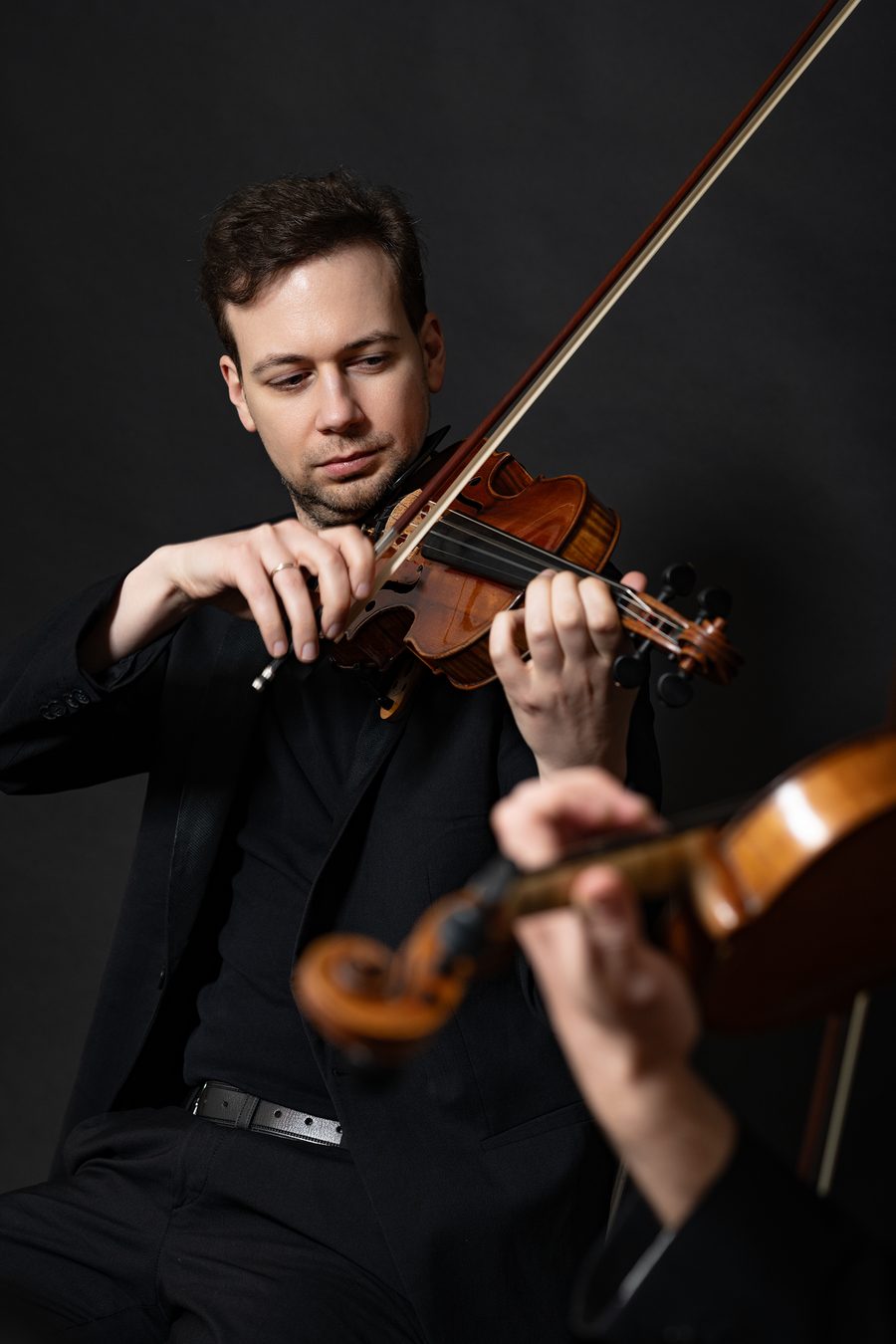
Daniel Auner has been internationally acclaimed as a violinist since his youth and is at the same time deeply rooted in the rich musical tradition of his native Vienna. The much-awarded “master violinist” (Die Presse), among other honours winner of the KlassikPreis Österreich and of the Eugène Ysaÿe Competition, performs worldwide as a soloist, chamber musician and conductor.
As primarius and founder of the Auner Quartett and a member of the Wiener Mozart Trio, he devotes himself to chamber music with particular passion. Since 2020 he has been General Music Director of the Mödling Symphony Orchestra. He teaches as professor of violin and chamber music in Vienna and at the summer academy of the Mozarteum University Salzburg. Daniel Auner plays a violin by Giovanni Battista Guadagnini from the collection of valuable string instruments of the Austrian National Bank.
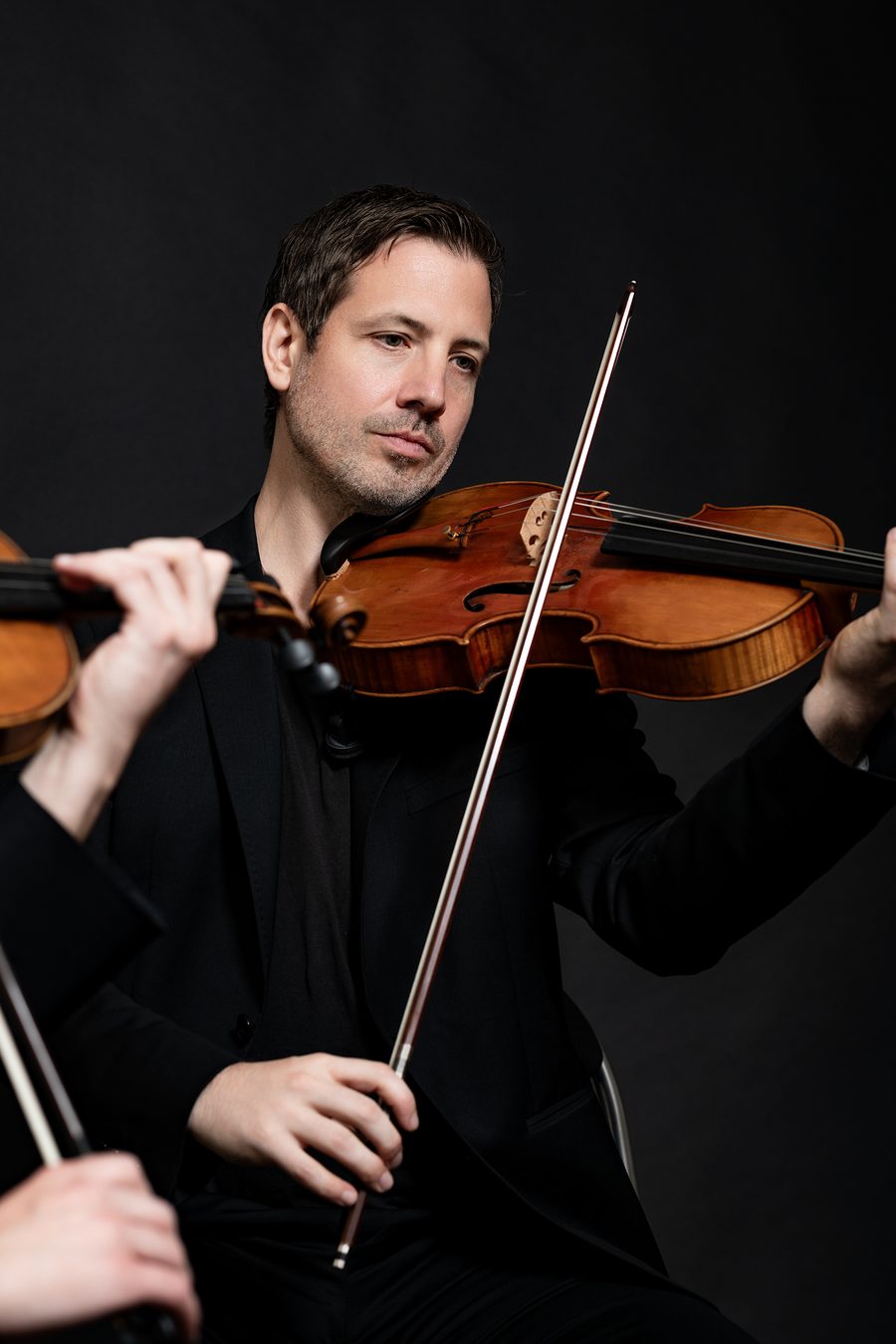
Cristian Ruscior was born in Romania in 1992. He taught violin for three years at the Barenboim-Said Foundation in Ramallah. Since 2018 he has been concertmaster of the Etihad Chamber Orchestra in Amman, Jordan. In February 2019 he won a fixed-term contract with the Vienna Symphony, and in March of the same year he became primarius of the Marc Aurel Quartett.
In November 2021 he won the audition for the stage orchestra of the Vienna State Opera; since then he has also performed with the orchestra of the Vienna Philharmonic. Ruscior studied at the University of Music and Performing Arts Vienna with Prof. Marina Sorokowa and Prof. Leonid Sorokow. He is a prizewinner of the International Violin Competition Gorizia, among others.
Georg Wimmer
viola
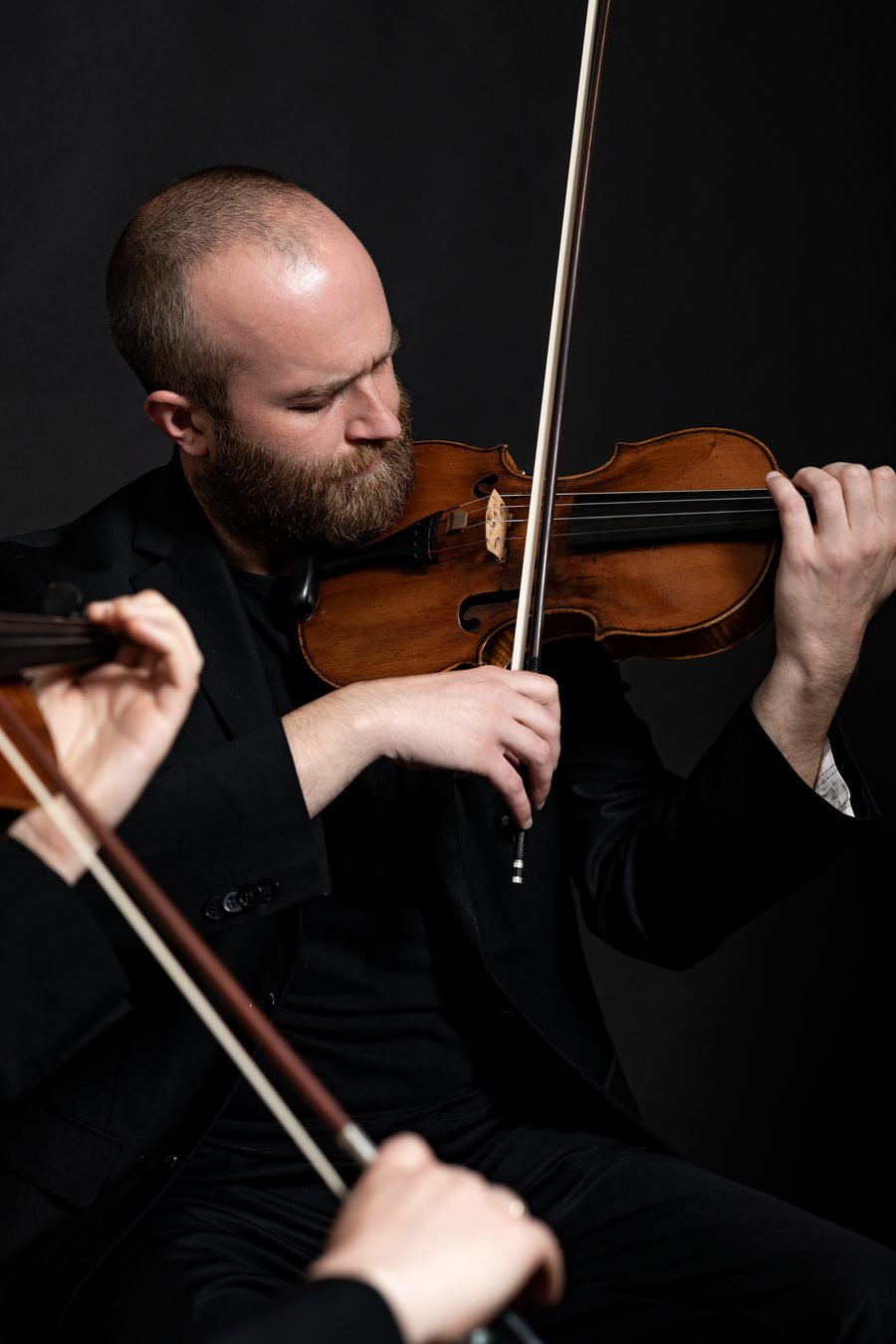
Georg Wimmer was born in Lambach, Upper Austria, in 1982. He began his studies in 1995 with Prof. Jürgen Geise at the Mozarteum Salzburg and moved after two years to Prof. Alfred Staar at the Bruckner Conservatory in Linz. From 2001 he studied in the performance class of Prof. Günter Pichler at the University of Music and Performing Arts Vienna.
Since autumn 2004 he has been a substitute with the Vienna State Opera / Vienna Philharmonic, from the 2006/07 season on fixed-term contracts with the stage orchestra of the Vienna State Opera and, until May 2026, in the first violin group of the State Opera orchestra. Following a successful audition in January 2026, Georg Wimmer has been a member of the viola section of the ORF Vienna Radio Symphony Orchestra since May 2026.
Konstantin Zelenin
violoncello
Konstantin Zelenin, born in Minsk in 1983, received his first cello lessons at the age of six and comes from the rich tradition of the Russian cello school. He trained at the music gymnasium in Minsk, at the Moscow Tchaikovsky Conservatory with Prof. Natalia Shakhovskaya and at the Music and Arts University of the City of Vienna with Prof. Natalia Gutman.
He is a three-time scholarship holder of the “Special Foundation by the President of the Republic of Belarus for Talented Youth” and a prizewinner of international competitions, including the Grand Prix at the “Arts of XXI Century” competition in Kyiv. He is a founding member of the Auner Quartett. Since 2016 he has taught at various conservatories and institutions in Vienna.
Photo: Damián Posse
The instruments
The first violinist’s instruments
All four musicians play historical instruments from the collection of the Austrian National Bank and from private foundations. Two violins of Daniel Auner’s have a story of their own.
On permanent loan from the Austrian National Bank
Giovanni Battista Guadagnini, Milan
As a rule Daniel Auner plays a violin by Giovanni Battista Guadagnini, on permanent loan from the collection of historical string instruments of the Austrian National Bank. The label names Milan; the last two digits of the year are illegible, and the OeNB dates the instrument to 1751–1753. By that time Guadagnini had perfected his characteristic style.
It is a medium-arched model of very balanced proportions, with a reddish varnish over a golden-yellow ground. The latest annual ring of the belly has been dated to 1731. The National Bank describes the instrument as tonally outstanding and in very good condition.
For the works of Mary Dickenson-Auner he changes instruments and plays her own violin — in the first concert of the cycle, for instance, her String Quartet No. 4. Outwardly it is a German factory instrument with a material value of less than a hundred euros — yet its sound is that of far more expensive instruments, and to this day no one can explain why.
The name goes back to Karl Fisselthaler, whom the composer describes in her memoirs as a mysterious “refiner of sound”. What he did to the violins he kept strictly secret; the method was lost with his death. The violin maker Hermann Löschberger, who restored the instrument, found no visible interventions.
Supported by
The Auner Quartett is supported by the OeNB Austrian National Bank, the clothing manufacturer Habsburg, and the Viennese string manufacturer Thomastik-Infeld.