Auner Quartett
Just released

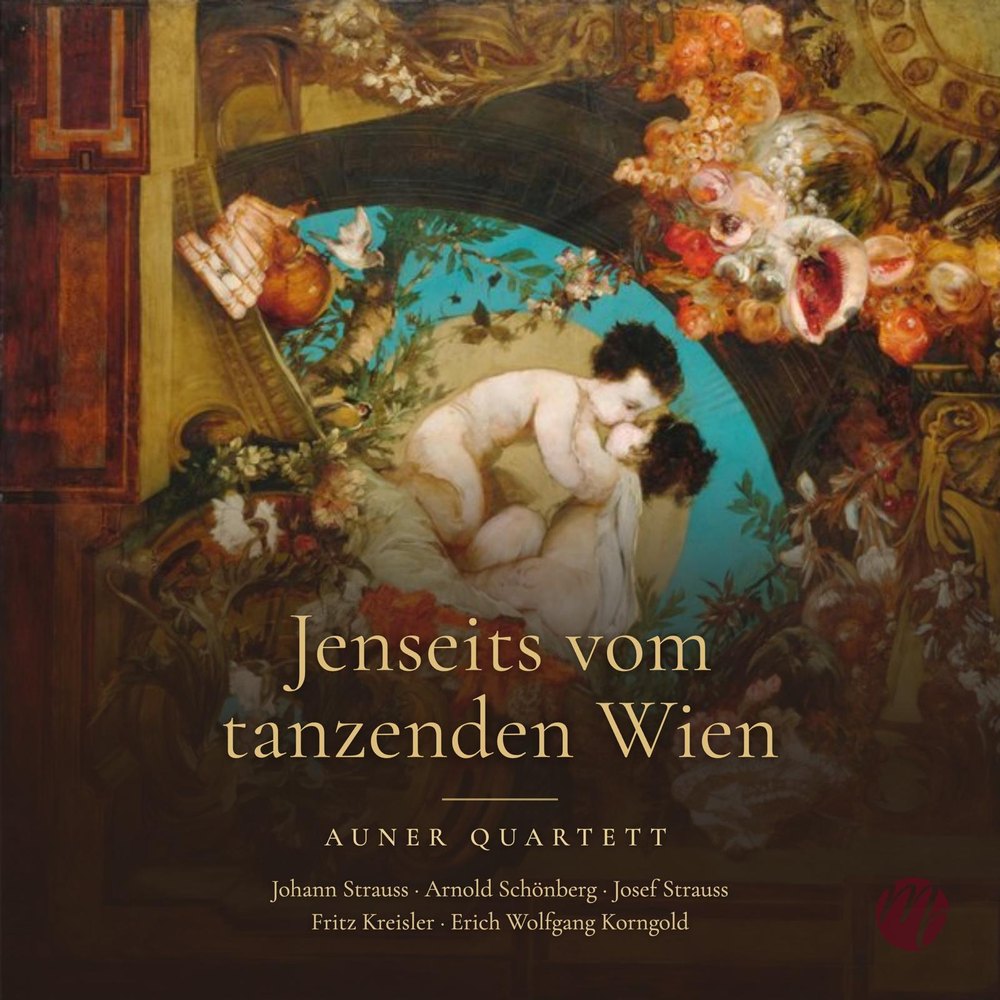
Jenseits vom tanzenden Wien


The recording that belongs to the cycle: two dance pieces by the Strauss brothers in the quartet’s own arrangements, Schoenberg’s early D major quartet, Kreisler’s “Bekenntnis zu Wien” and Korngold’s “Glück, das mir verblieb”.

Jenseits vom tanzenden Wien
Cover: © MB Records

Released 23 October 2026 · MB Records · 11 tracks, 71 minutes · recorded October 2025


The recording that belongs to the cycle: two dance pieces by the Strauss brothers in the quartet’s own arrangements, Schoenberg’s early D major quartet, Kreisler’s “Bekenntnis zu Wien” and Korngold’s “Glück, das mir verblieb”.

The album is released digitally. Further platforms are being added.

From the booklet

Diesseits und Jenseits — this side and beyond

Hardly any city has let its own image be dictated to it as readily as Vienna, which has moved through Europe’s imagination in three-four time since the late nineteenth century — an image that is not untrue, but that passes over how far the music of the ballrooms reached beyond their doors. It did not stay where it had come into being; it moved into studios and studies, into the quartet evenings of bourgeois houses and finally into the scores of those composers who counted themselves part of the serious genre. The aura of the Strauss family and its particular melodic tone shaped compositional Vienna more deeply than the familiar division between entertainment and art would like to admit.

The series that the Auner Quartett has devoted to this connection therefore rests not on a sequence but on a simultaneity: this side of the dance, and the beyond of its resonance in the chamber music of the same city and the same decades. How close the two stood is attested by a photograph in the Arnold Schönberg Center, in which Fritz Kreisler on the violin and Arnold Schoenberg, a self-taught cellist, play the melodies of Johann Strauss at a Heuriger outside the city. From that Viennese sound, which Kreisler made self-evident with a continuous vibrato on every note, a straight line runs into the performing practice of the twentieth century: the vibrato markings formerly written out one by one gradually disappeared from the scores, because no one thought them necessary any longer.

The five composers of this recording belong to a single circle. Schoenberg wrote his D major quartet in 1897 under the eyes of Alexander von Zemlinsky, his teacher, friend and later brother-in-law, with whom the young Korngold studied a few years afterwards; Kreisler in turn embodied the very tone against which Schoenberg set out and which nonetheless remained familiar to him all his life. Above them all stand the Strauss brothers, against whom anyone composing in Vienna either laboured or to whom they surrendered.

What binds this music together is, in the end, also what befell it. Three of the composers recorded here were driven out by National Socialism — Schoenberg in 1933, Korngold in the years that followed, Kreisler definitively after the “Anschluss” — while the long-dead Strausses were appropriated against their will; in order to declare Johann Strauss a German master undisturbed, the regime had his partly Jewish genealogy falsified. The city these works come from made itself, a few years later, into a dead city, and so the three arrangements that open, divide and close this programme are less an encore than a frame.

The programme

Eleven tracks

Johann Strauss II 1825–1899

Frühlingsstimmen, Waltz op. 410

Version for string quartet by Daniel Auner (Universal Edition Vienna, 2023)

  • 1 6:37
About the workShow less

The waltz taken today for the very essence of the ballroom was originally written for a voice: Strauss composed it in 1882/83 for the coloratura soprano Bertha Schwarz, celebrated at the Court Opera under the name Bianca Bianchi, who sang it for the first time on 1 March 1883 at a charity matinée at the Theater an der Wien; the text was written by Richard Genée, and the piano reduction is dedicated to Alfred Grünfeld. Its great success came only with some delay, on the Russian tour of 1886 and by way of that very piano version, which carried the waltz into bourgeois drawing rooms.

Its opening already sets it apart from his great concert waltzes: where those unfold out of an extended introduction, here the first theme enters at once, and what follows is less a chain of dance movements than a single, breathless ascent. Its origin in the singing voice remains audible in every turn of phrase — in the runs and leaps written for a coloratura soprano, and in the way the melody does not close its phrases but drives them onward.

Daniel Auner’s version for string quartet, published by Universal Edition in 2023, proceeds from the orchestral setting, in which most of the melodic lines are entrusted to the strings in any case; it seeks to translate what is peculiar to this music into a small ensemble of the kind the Viennese salons of the time employed. Since the Viennese string quartet was then usually joined by a double bass, the cello here must carry downwards much of what originally lay beneath it — a shift that takes nothing from the piece, since its momentum comes from above in any case.

Arnold Schoenberg 1874–1951

String Quartet in D major (1897)

  • 2 I. Allegro molto 8:51
  • 3 II. Intermezzo. Andantino grazioso 4:07
  • 4 III. Andante con moto 8:03
  • 5 IV. Allegro 4:53
About the workShow less

The first larger work by the twenty-three-year-old to survive complete bears no opus number, since Schoenberg began his count only a year later with the songs; as models he himself named Mozart, Beethoven, Brahms and Dvořák. The decisive part, however, was played by Alexander von Zemlinsky, to whom the young composer submitted the manuscript and who advised reworking the first movement and replacing the second entirely — the third, too, was probably newly written in consequence. Only then did Zemlinsky, as a board member of the Wiener Tonkünstlerverein, secure the performance: on 17 March 1898 in private, and publicly on 20 December of the same year by the Fitzner Quartet in the Bösendorfer-Saal.

The Neue Freie Presse spoke of a very agreeable surprise and credited the author with a true talent that had here spoken its first significant word; one understands the verdict on following the buoyant sonata movement with its broadly laid-out second subject, the Intermezzo of song-like grace, the five variations on a theme first presented by the cello, and a finale of robust delight in playing. Anyone hearing the work without its composer’s name would hardly think of Schoenberg, and yet one can already trace how great things are developed here out of the smallest motifs — a procedure for which he later found the term developing variation.

Josef Strauss 1827–1870

Brennende Liebe, Polka Mazur op. 129

Version for string quartet by Daniel Auner (Universal Edition Vienna, 2023)

  • 6 4:44
About the workShow less

The middle of the three Strauss sons was the most reluctant musician of the family: Josef Strauss had completed a technical training and worked as an engineer and draughtsman before taking over the orchestra in 1853, because his brother Johann had fallen ill — and he stayed with it until his early death in 1870, at the age of forty-three. What he wrote in those seventeen years is held by many to be the musically finest work of the dynasty.

The Polka Mazur op. 129 is not a polka in the ordinary sense: it stands in three-four time, moves considerably more slowly than its sisters, and lives on the displacement of the accent onto the second or third beat — a Polish dance, then, in Viennese dress, whose tenderness recalls Schubert rather than a ballroom.

The circumstances of its composition explain this tone. When Johann broke off his guest season at Pavlovsk near St Petersburg in the summer of 1862 in order to marry Jetty Treffz at St Stephen’s Cathedral on 27 August, Josef had to travel to Russia at a moment’s notice and finish the season for him — while his own wife Caroline, whom he had married five years earlier, stayed behind in Vienna. The piece is addressed to her, and its title means nothing allegorical.

This version for string quartet is likewise by Daniel Auner and published by Universal Edition. In the programme the piece stands on the threshold, behind Schoenberg’s youthful work and before Kreisler’s backward glance from exile.

Fritz Kreisler 1875–1962

String Quartet in A minor “Bekenntnis zu Wien” (1919)

  • 7 I. Fantasia. Allegro moderato 8:19
  • 8 II. Scherzo. Allegro vivo con spirito 6:47
  • 9 III. Introduction and Romance. Allegretto – Andante con moto 5:24
  • 10 IV. Finale. Allegro molto moderato 7:54
About the workShow less

Kreisler, born in Vienna, a volunteer in the First World War and wounded in it, had lived in the United States since 1915, and it was there that his only string quartet came into being; the première was given on 26 April 1919 by the Letz Quartet in New York. Of the work he said that it was his avowal of Vienna, and he would reveal no more than that — he never engaged with the obvious question of an autobiographical programme.

All four movements carry titles. The Fantasia opens with a cello solo of dark drama and then strings themes and moods freely together before returning literally to the beginning; the Scherzo dances with an agility that owes much to Mendelssohn, and in its calmer middle section gives the floor to the individual instruments. In Introduction and Romance, the extended introduction is set against a song led by the first violin, whose harmony towards the end reaches into adventurous territory over a pizzicato cello, before the finale closes the arc.

The tone is other than in Liebesleid or Schön Rosmarin: here Kreisler sought not the salon piece but the large form, without finding his way back to the idiom of Brahms. What emerged is an attempt to hold on to a city while it disappears. Nineteen years later, after the “Anschluss”, Kreisler, who was of Jewish descent, left Europe for good; he took American citizenship and hung the framed Austrian certificate on the wall of his apartment. He died in New York in 1962.

Erich Wolfgang Korngold 1897–1957

Marietta’s Lied “Glück, das mir verblieb” from the opera Die tote Stadt op. 12

Version for string quintet by Thomas Auner (Schott Music, Mainz, ED 24079 · Q875946)

  • 11 5:30
About the workShow less

Korngold was born in the same year in which Schoenberg completed his D major quartet; he too was Zemlinsky’s pupil, and his father Julius was the most powerful music critic in Vienna. Die tote Stadt op. 12, after Georges Rodenbach’s novel Bruges-la-Morte, was premièred simultaneously in Hamburg and Cologne on 4 December 1920 and made the twenty-three-year-old world-famous; the libretto had been written by the family itself under the shared pseudonym Paul Schott.

In the opera, Marietta’s Lied is not a solo but a duet: Paul, the widower, recognises his dead wife in the dancer Marietta, and in the singing the two images of the woman merge in a dangerous way. It is precisely this double ground that makes the piece the close of the programme — a song about the happiness that has remained, sung over a loss.

The version for string quintet is by Thomas Auner and is published by Schott Music. The second cello, which he takes himself, gives the music the depth and the shadow that Korngold’s orchestral writing has in mind, and lets the vocal line travel through the ensemble rather than resting in one place. From 1933 onwards Korngold’s music was banned from German stages; he went to Hollywood, wrote film music and remained, as he himself knew, a Viennese composer without Vienna.

Recording details

Performers on this recording
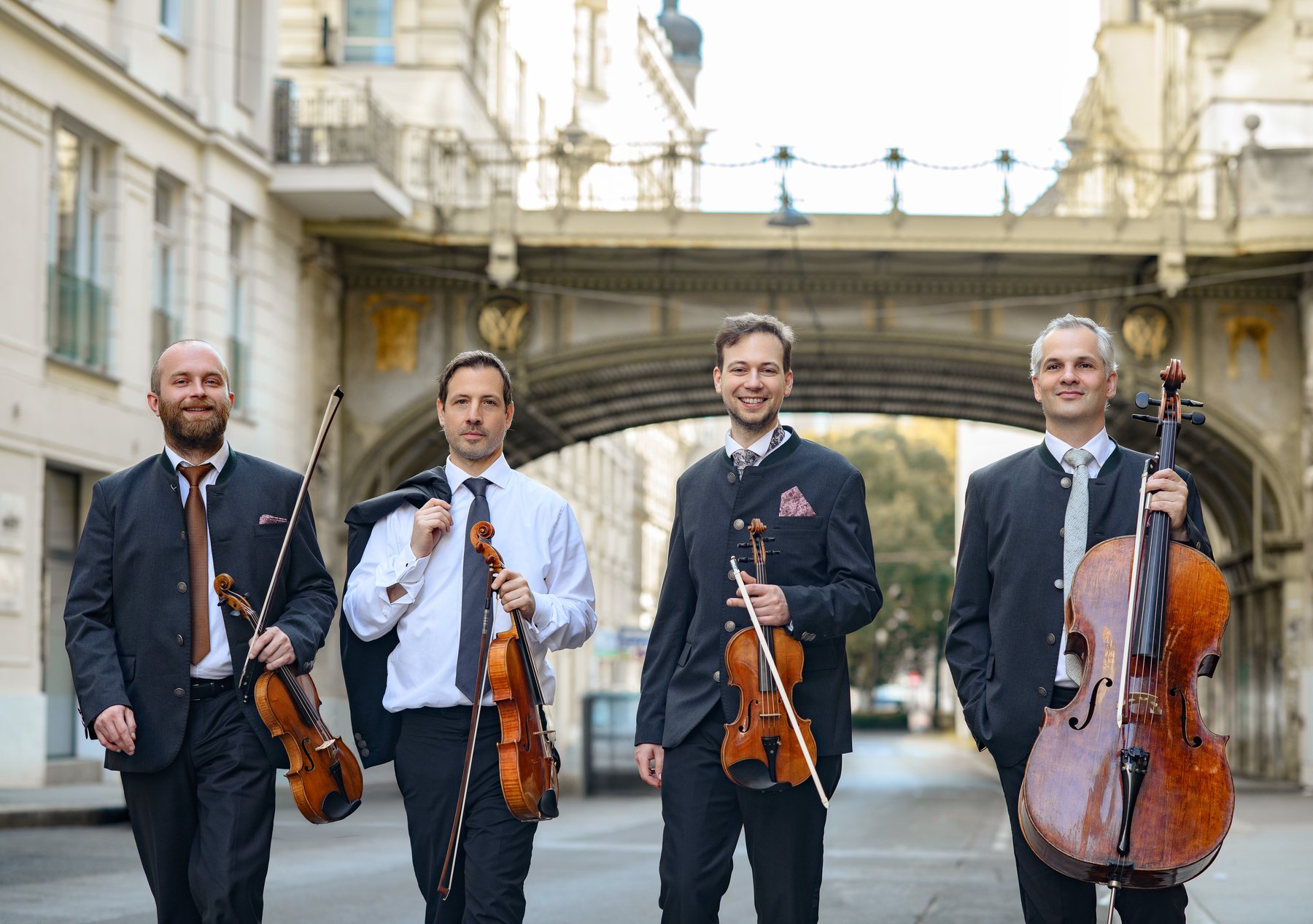
Daniel Auner, violin · Cristian Ruscior, violin · Gabriel Squizzato, viola · Konstantin Zelenin, cello. Guest: Thomas Auner, cello (11).

Recording
October 2025. Recording engineer: Marco Battistella. Released by MB Records on 23 October 2026. Total playing time 71:09.

Instruments
Daniel Auner plays a violin by Giovanni Battista Guadagnini (Milan, c. 1751–1753), Gabriel Squizzato a viola by Giovanni Battista Ceruti (Cremona, c. 1810); both are permanent loans from the collection of historical string instruments of the Oesterreichische Nationalbank. Thomas Auner plays the cello by Giovanni Battista Grancino (Milan, 1706) named after the cello virtuoso Alfredo Piatti, likewise on loan from the Oesterreichische Nationalbank, and Konstantin Zelenin a cello by Giovanni Battista Grancino from a private collection.

Publishers
Frühlingsstimmen op. 410 and Brennende Liebe op. 129 in the versions for string quartet by Daniel Auner: Universal Edition AG, Vienna. Marietta’s Lied in the version for string quintet by Thomas Auner: Schott Music GmbH & Co. KG, Mainz, ED 24079 · Q875946.

The first review

Vom vergänglichen Wiener Glanz …

Supersonic, PizzicatoRemy Franck, Pizzicato, 23 October 2026

The Vienna-based Auner Quartet opens this program with a lively, at times forcefully accented interpretation of the Voices of Spring waltz.

Schönberg composed his D major quartet in the fall of 1897 at the age of 23, under the guidance of Alexander von Zemlinsky and with Brahms as an inspiration. It is a late-Romantic, luminous work, often dance-like and lively, into which the Auner Quartet also weaves small gray clouds and, in the Andantino grazioso, a great deal of melancholy. Even the variation movement, Andante con moto, is anything but consistently carefree and points toward the kind of expressiveness that characterizes Schoenberg’s later, atonal quartets. This shows that the Auner Quartet by no means dismisses this early composition lightly, but rather enhances the music through genuine expressiveness and presents it as a perfectly conceived late-Romantic gem with a finale played with genuine enthusiasm.

Fritz Kreisler’s rarely heard A-minor Quartet from 1922 receives a similar elevation. Although the composer described it as a tribute to Vienna, the music suggests far more than that.

The opening Allegro moderato is dramatic and passionately turbulent, which comes across more strongly in this interpretation than in those by the Fine Arts Quartet or the Artist Quartet.

The scherzo, Allegro vivo con spirito, is played with urgency and energy. Even the trio section, with its nostalgic allusions to a bygone Vienna, never sounds lackluster here.

The slow movement, Andante con moto, Introduction & Romance, reinforces the sense of loss — whether of the splendor of the Habsburg era or of musical Romanticism — that had already emerged in the scherzo.

The finale takes up a Viennese dance melody, played with great rhythmic cheerfulness.

Very symbolically, the album then concludes with a string quartet arrangement of Glück, das mir verblieb from Korngold’s Die tote Stadt, even though it is not set in Vienna but in the Flemish city of Bruges.

The lyrics of this song speak of the joy of love, yet they also convey a sense of sadness about the transience of a fleeting world.

This is a deeply profound conclusion to this artistically superb program, which is also exemplary in its sound — with its warm richness, perfect balance, and transparency.

The review at Pizzicato

Vienna Musikverein · Season 2026/27

The cycle at the Musikverein


Four concerts at the Wiener Musikverein from 25 November 2026, with works by Zemlinsky, Mary Dickenson-Auner, Wellesz, Webern and Kreisler, and Thomas Hampson as guest.

More information

Auner Quartett